
Whenever you book a train ticket and see codes like RLWL, GNWL, PQWL, etc., your heart might skip a beat, wondering: “Will I get a berth, or end up stranded?” RLWL Remote Location Waiting List is one of those codes that often causes confusion, especially for travelers boarding from intermediate stations rather than origin points. In the SwaRail (or Indian Railways/IRCTC) system, RLWL has its own unique logic, advantages, and drawbacks. In this article, I’ll walk you through RLWL in a human-friendly way: how it works, what influences confirmation chances.
What RLWL Means And Why It Exists?
Think of RLWL as a lifeline for travelers boarding at important intermediate stations that lie between the origin and the final destination of the train. RLWL stands for Remote Location Waiting List. In simple terms, when the quota of confirmed tickets for your desired segment is exhausted (for that remote boarding station), the system assigns you RLWL instead of the general waitlist (GNWL).
Why does this category exist? Because Indian Railways wants to ensure that people who board from mid-route stations (not the start) still get a fair shot. If only origin passengers consumed all seats, many intermediate travelers would lose out. RLWL ensures a dedicated buffer (quota) for these “remote” stations.
However, RLWL comes with trade-offs. The confirmation chances are generally lower than GNWL (because cancellations at remote stations tend to be fewer) and the final allotment often happens close to departure. Also, seats reserved under RLWL are limited.
So, RLWL is neither a guaranteed berth nor purely hopeless; it’s a middle ground tailored for intermediate station travelers.
How RLWL Ticketing Works?
Here’s a breakdown (with both narrative and bullet points) of the mechanics behind RLWL in the SwaRail app / IRCTC:
When you book:
- If your boarding station is one of the designated “remote locations” (intermediate, important stop) and confirmed seats are already filled, your ticket gets RLWL rather than GNWL.
- The system treats RLWL as a separate bucket of the waiting list, with its own numbering (e.g., RLWL 5, RLWL 10) distinct from GNWL numbering.
- As time progresses, if someone who had a confirmed ticket (for that remote station segment) cancels, the RLWL list moves up and may get confirmation.
- Charts for remote locations are prepared separately (usually 2–4 hours before departure) so that last-minute cancellations specific to those stations are considered.
- If RLWL does not convert to confirmed by charting time, it may be auto-cancelled (for e-tickets) and refunded.
This process places RLWL in a more constrained ecosystem compared to general waitlist systems.
Differences Between RLWL And Other Waiting Lists:
Understanding RLWL in isolation is helpful, but seeing how it stacks up against other waiting list types gives more clarity. Let’s compare RLWL with GNWL, PQWL, RQWL, and TQWL via a side-by-side lens:
Characteristics & Comparison
| Waiting List Type | Who It Serves | Confirmation Priority / Chances | Key Dependency | Boarding Flexibility |
| GNWL (General WL) | Passengers from the origin or stations closest to the origin | Usually higher chance | Cancellations anywhere on the route | Can commence the journey from the origin |
| RLWL | Passengers boarding at remote intermediate stations | Lower than GNWL typically | Cancellations specific to the remote station’s quota | Only from that specific remote station |
| PQWL (Pooled Quota WL) | Small stations grouped together | Moderate to low | Shared pool cancellations | Flexible among small stations |
| RQWL (Request WL) | When not covered by WL, RLWL, or PQWL | Very low | Rare cancellations | Very restricted |
| TQWL (Tatkal WL) | Tatkal bookings waiting list | Lowest among these | Last-minute cancellations | Strict time windows |
From this table, you can see why RLWL sometimes is preferable to RQWL or PQWL, at least it has its own quota and possibility of movement, but it generally has less priority than GNWL. RLWL’s uniqueness lies in tying waiting status to a remote boarding station’s specific cancellation pool, which makes it both fair (for those mid-route) and riskier (because cancellations are fewer).
Factors That Affect RLWL Confirmation Chances:
When you find yourself in RLWL, it’s natural to wonder: “Do I stand a chance?” The answer depends on several factors, some in your control, others not. Understanding them empowers you to strategize better.
Major Influencing Factors
- Cancellation Patterns at Remote Station: If many passengers boarding from your remote station cancel at the last minute, RLWL moves faster. But because remote stations usually have fewer passengers and cancellations, the movement is often slower.
- Booking Timing: The earlier you enter RLWL (i.e. book ahead), the higher the probability of climbs before charting. Late bookings often leave insufficient cushion.
- Train Type & Route Occupancy: On heavily used routes or popular trains, RLWL is more frequent and movement is trickier because many people compete for limited quotas.
- Quota Allocation: How many seats the system reserves for the RLWL category impacts movement. If the designated quota is very small, even a few cancellations may not help much.
- Number in Queue: If your RLWL number is small (say RLWL 2 or 3), you are much better placed vs. RLWL 40 or 50.
- Time to Departure (Chart Preparation): As time nears the departure, there’s less scope for new cancellations to affect RLWL status. Most movement happens in the last hours.
Some of these you can influence (book earlier, pick a smaller queue), others are systemic. The more you understand these, the better you can interpret your RLWL position and plan contingencies.
Rights, Responsibilities, And Limitations Under RLWL:
Being in RLWL doesn’t just come with uncertainty, it carries certain rights and constraints. Knowing them helps avoid surprises.
- Boarding Restriction: You must board at the specific remote station you booked (or listed). You can’t join earlier or later unless the ticket is confirmed for an alternate boarding point.
- Cancellation / Refund: If the RLWL status doesn’t convert by charting, an e-ticket is auto-canceled, and you receive a refund to your source account (usually within a few days).
- No Travel with Unconfirmed: You are not allowed to travel with a purely waitlisted RLWL ticket. If it remains RLWL after charting, you have no right to occupy a seat or berth.
- Partial Confirmation Possibility: If your ticket is mixed (some passengers confirmed, others RLWL), partial travel may be permitted, those with confirmed berth travel, others wait.
- Transfer / Upgradation: In rare cases, if higher class seats free up, an RLWL ticket might upgrade automatically (if the system or you have opted), but this is not guaranteed.
- Interaction With Charting: Final allocation for RLWL happens close to train departure, so waiting till charting time is inherent.
In short: RLWL gives opportunity, but not a guarantee. You have the right to cancellation and refund, but no right to a berth until confirmation.
Practical Tips To Handle RLWL Effectively:
Here’s a set of 6–7 actionable tips (in a structured list) to maximize your chances or reduce inconvenience when stuck in RLWL:
- Book As Early As Possible: The earlier your booking, the more buffer to climb the RLWL ladder before charting.
- Monitor PNR Status Frequently: Keep checking (via IRCTC app, SMS, or websites) so that if your status changes,you know quickly.
- Aim For a Lower RLWL Number: When booking, if you see “current RLWL 35” vs. “RLWL 5,” obviously choose the latter route or time if possible.
- Be Prepared With Backups: Always have an alternate train, bus, or travel plan, especially if your RLWL number is high.
- Travel Light / Flexible: If your ticket gets partially confirmed late, you might need to share a berth or accept alternate seating.
- Board From Specified Remote Station Only: Don’t attempt to board earlier or later; doing so may be disallowed.
- Cancel In Time (if needed): If your RLWL is hopeless, cancel early (for counter booking) to avoid last-minute complications.
These tips don’t guarantee magic, but they help you navigate RLWL more confidently and avoid unpleasant surprises as your travel date nears.
How RLWL Shows In Your PNR Status?
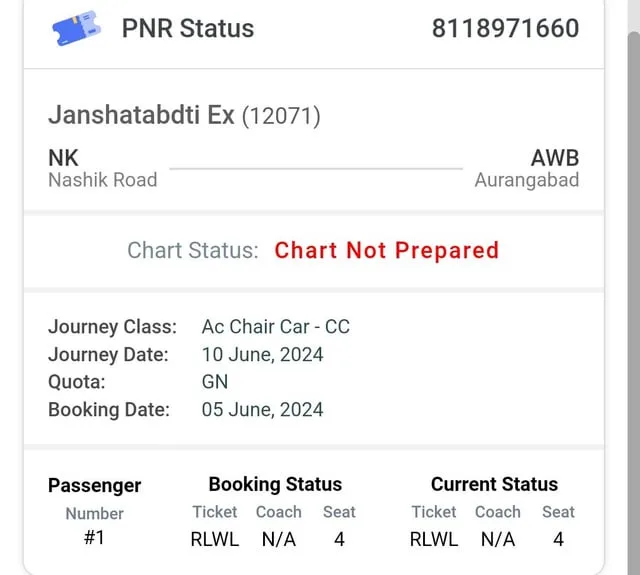
When you book a ticket and it falls under RLWL, your PNR (Passenger Name Record) will clearly display it. Typically, it shows as “RLWL 12 / RLWL 5” or similar. The first number indicates your original waitlist number at the time of booking, and the second shows your current position after cancellations.
- Example: RLWL 15 / RLWL 8 means when you booked, you were the 15th in the queue. Due to cancellations, you have now moved up to 8th.
- If it becomes “CNF” in the status, it means your seat is confirmed.
- Sometimes you might see “RLWL / RAC” which means your ticket has moved into the Reservation Against Cancellation zone, giving you partial travel rights.
PNR updates are dynamic. They shift based on cancellations in the quota tied to your remote station. Therefore, passengers must keep checking their PNR until chart preparation. For e-tickets, the IRCTC system sends SMS/email updates too.
Real-Life Experiences Of RLWL Passengers:
Many travelers share mixed emotions about RLWL, some remember it as a miracle saver, while others as a heartbreak.
- The Lucky Ones: Passengers with RLWL 2 or 3 often see their tickets confirmed hours before departure, especially during off-peak seasons. They board with relief and pride in having “taken the chance.”
- The Unlucky Ones: Those with higher RLWL numbers say 30 or 40,often face disappointment. Their tickets remain unconfirmed until the last minute, and they scramble for buses or other trains.
- The Emotional Ride: RLWL is often described as “the waiting list of suspense.” Passengers refresh PNR status repeatedly, sometimes every hour, in hope of confirmation.
These lived experiences show RLWL isn’t just a technical code, it’s an emotional journey. It teaches patience, backup planning, and sometimes, the thrill of last-minute wins.
Myths And Misconceptions About RLWL:
Over time, many myths about RLWL have circulated. Clearing them up helps travelers make informed decisions.
- Myth 1: RLWL Never Gets Confirmed – Wrong. Though chances are lower than GNWL, many RLWL tickets do get confirmed, especially with smaller numbers.
- Myth 2: You Can Travel On Unconfirmed RLWL – Incorrect. With e-tickets, unconfirmed RLWL automatically cancels, and you cannot board.
- Myth 3: RLWL And GNWL Have The Same Priority – No. GNWL is prioritized higher during allotment. RLWL depends only on cancellations at your specific station quota.
- Myth 4: All Stations Have RLWL – Not true. Only certain remote stations are allocated RLWL quotas.
- Myth 5: Partial Confirmation Means All Can Travel – Wrong. Only passengers with confirmed berths can travel, others cannot.
Understanding these realities saves people from frustration and wrong assumptions.
Technology And RLWL Movement:
Technology has transformed how RLWL is managed and tracked. Gone are the days when passengers had to stand in long queues just to ask about status.
- IRCTC/SwaRail App: Shows real-time PNR status, allowing passengers to track movement from booking till charting.
- SMS Alerts: Automated updates about status change are sent to registered numbers.
- Predictive Tools: Many third-party apps use AI to predict RLWL confirmation chances based on historical trends.
- Chart Preparation Updates: Technology ensures that remote station charting is synced into the central system, giving last-minute clarity.
- E-Ticket Automation: If unconfirmed, e-tickets auto-cancel and refunds are triggered digitally, reducing hassle.
This tech-driven approach makes RLWL easier to understand and less stressful, although the core uncertainty remains.
Strategies To Avoid Getting RLWL:
While sometimes unavoidable, smart planning can help minimize chances of ending up with RLWL tickets.
Steps You Can Take:
- Book Early – The sooner you book, the higher the chance of a confirmed seat under GNWL.
- Prefer Origin Stations – If possible, book from the train’s starting point; GNWL has better chances than RLWL.
- Check Alternate Trains – Sometimes a less popular train on the same route has availability.
- Use Tatkal Quota – Tatkal opens a day before; it may help when regular tickets are exhausted.
- Flexible Dates – Shifting your journey by a day or two may avoid RLWL completely.
- Check Different Classes – If sleeper is in RLWL, try AC or vice versa.
- Travel Off-Peak – Avoiding festivals and holiday rush significantly reduces chances of RLWL.
These steps are not foolproof but improve your odds of getting confirmed berths upfront.
Future Of RLWL Under SwaRail:
With modernization of SwaRail and Indian Railways, RLWL may undergo changes.
- AI Predictions: Future booking systems might predict RLWL chances more accurately, so passengers can decide instantly whether to book or avoid.
- Dynamic Quota Reallocation: Authorities may introduce systems where unused quotas automatically merge into RLWL, improving confirmation chances.
- Seamless Refunds: Already fast, refunds may become instant with UPI integration.
- Greater Transparency: Future tech could show how many cancellations typically happen at your remote station, giving travelers realistic expectations.
- Possible Phasing Out: With increased train frequency and better seat management, RLWL may become less relevant in future.
Thus, while RLWL may frustrate many today, it’s evolving toward a smarter, more transparent system.
Conclusion:
RLWL in train booking (SwaRail) is both a blessing and a curse. It ensures intermediate station passengers have access to seats, but at the cost of uncertainty and lower priority compared to GNWL. By understanding how RLWL works, its limitations, myths, and strategies to handle it, passengers can travel smarter. With technology improving every year, RLWL might become less stressful, but until then, it remains a game of patience and planning.
FAQs:
No. For e-tickets, RLWL is auto-cancelled if not confirmed. For counter tickets, you cannot occupy a berth with unconfirmed RLWL.
GNWL applies to origin stations and has higher confirmation chances. RLWL is specific to remote stations and relies only on cancellations at that quota.
Yes. For e-tickets, the amount is refunded automatically to your bank/wallet account.
Book early, prefer origin stations, check alternate trains, or use Tatkal quota if possible.
Not at all. Smaller RLWL numbers often get confirmed, especially closer to departure. The higher the number, the slimmer the chances.